



Mold-Free Coffee: What It Is, Why It Matters, and the Best Brands

Searching for mold-free coffee that's actually third-party verified? Most brands claim "mold-free" without proof. Pangea Coffee is SPOKIN-verified—America's first certified allergen-free coffee facility, with mold-free, Q-grader inspected beans. Discover what makes truly mold-free coffee different.
What Is Mold-Free Coffee? (And Why Most Brands Can't Prove It)
Mold-free coffee means coffee that's been processed, stored, and roasted in conditions that prevent mycotoxin contamination—the toxic compounds produced by mold that can affect your health. The problem? Most coffee brands claim "mold-free" without third-party verification.
Here's what actually makes coffee mold-free:
- Proper sourcing from regions with optimal growing conditions and careful post-harvest processing
- Quality control inspection throughout the supply chain—either through laboratory analysis or trained Q grader evaluation
- Clean roasting facilities that prevent cross-contamination
- Third-party certification (like SPOKIN) that validates allergen-free and contamination-free protocols
At Pangea Coffee, we're SPOKIN-verified— the first coffee company in America to achieve third-party certification for allergen-free, contamination-conscious coffee production. Our Q graders inspect every batch, and our facility maintains strict protocols to ensure your coffee is as clean as it is delicious.
The Health Risks of Moldy Coffee: What Research Actually Shows
Coffee can become contaminated with mycotoxins—toxic compounds produced by molds like Aspergillus and Penicillium—during growing, processing, storage, or roasting if conditions aren't carefully controlled.
The most concerning mycotoxin in coffee is ochratoxin A (OTA), which has been detected in some coffee samples worldwide. While regulatory agencies like the FDA and EFSA monitor OTA levels, sensitive individuals or those consuming large amounts of coffee may want to minimize exposure.
Research on mycotoxins in coffee shows:
- Processing matters: Studies show that wet-processed (washed) coffee generally has lower mycotoxin levels than dry-processed coffee, and proper fermentation reduces contamination risk significantly.
- Storage conditions are critical: Coffee stored in humid conditions or for extended periods shows higher mycotoxin development.
- Roasting reduces but doesn't eliminate: While roasting can reduce some mycotoxin levels by 50-80%, it doesn't completely eliminate them, which is why prevention at the source matters most.
For people with mold sensitivities, compromised immune systems, or those who simply want the cleanest coffee possible, sourcing and facility standards are what reduce these risks.
Not sure which roast is right for you?
Answer five questions about your symptoms and we'll match you to a roast. Takes about thirty seconds, and you don't need to give us your email to see the result.
Find Your Roast →How Coffee Gets Contaminated: From Farm to Cup
Understanding how contamination happens helps you identify truly mold-free coffee:
At Origin (Growing & Harvesting)
Coffee cherries damaged by insects, left on the ground, or harvested during wet weather are more susceptible to mold. Quality-focused farms pick only ripe cherries and process them quickly to prevent contamination.
During Processing
The fermentation and drying stages are critical. If coffee isn't dried quickly enough (to below 12% moisture) or if fermentation is mismanaged, mold can proliferate. Wet processing with controlled fermentation is considered the cleanest method.
In Storage & Transport
Green coffee beans stored in humid conditions or poorly ventilated containers can develop mold during the weeks or months before roasting. Proper storage in climate-controlled facilities prevents this issue.
At the Roastery
Even if green beans arrive clean, roasting facilities that don't maintain strict contamination protocols can introduce problems. This is where SPOKIN verification makes a difference—our entire facility is certified allergen-free and follows protocols that prevent any contamination.
Pangea's Mold-Free Advantage
- Sourced from low-acid, high-altitude regions known for optimal growing conditions
- Q graders inspecting every batch before and after roasting
- SPOKIN-verified facility—third-party certified for allergen-free, contamination-free production
- Small-batch roasting ensures freshness and quality control
Mold-Free Coffee Brands: What to Look For (Beyond Marketing Claims)
Many coffee brands advertise "mold-free" or "mycotoxin-tested" coffee, but few can prove it. Here's how to identify legitimate mold-free coffee:
If you're also weighing brands on acidity, sourcing transparency and allergen standards, we've put the main options side by side in our low acid coffee brands comparison.
1. Third-Party Verification (The Gold Standard)
Look for: SPOKIN certification, USDA Organic with proper handling, or documented lab testing results from independent facilities.
Red flag: Brands that claim "tested" but don't show certificates or specify testing methods.
2. Processing Method Transparency
Look for: Brands that specify what type of processing, for example wet-processing (washed coffee), and source from reputable farms.
Red flag: No information about processing methods or origin details.
3. Roast Date & Freshness
Look for: Coffee roasted within the past 2-4 weeks with clear roast dates on packaging.
Red flag: No roast date, "best by" dates months or years out, or coffee sitting on shelves indefinitely.
4. Quality Grading
Look for: Specialty-grade coffee (80+ points) evaluated by certified Q graders.
Red flag: Commodity-grade coffee with no quality scoring information.
Why Pangea Coffee Stands Out
We're not just claiming mold-free—we're SPOKIN-verified, which means an independent third party has certified our entire operation. Our on-staff certified coffee experts (Q graders) inspect every batch. We source from high-altitude, low-acid regions where coffee naturally has fewer contamination risks. And we roast in small batches to ensure every bag meets our standards.
When you choose Pangea, you're choosing coffee with independent allergen verification and expert batch inspection behind it—not just a marketing claim.
What “Clean Coffee” Should Actually Mean
“Clean coffee” has become a crowded claim—and shoppers are right to be skeptical. Some brands center the conversation entirely on one signal: published mold or mycotoxin lab numbers. Lab testing is genuinely useful, and we’ll be straight about where it fits below. But a single number doesn’t capture what actually makes a cup clean, and it leaves out the contamination risk that sends the most people to the hospital: allergens.
A genuinely clean coffee should hold up across four questions, not one:
1. Is the facility verified allergen-free—by an independent third party?
This is the gap most “clean coffee” brands quietly skip. A roaster can source beautiful beans and still run them on equipment that handled flavored coffee last week. For anyone with a nut, dairy, gluten, or soy allergy, that’s not a quality footnote—it’s a safety issue. Pangea is SPOKIN-verified—the first coffee company in America to earn independent, third-party allergen-free verification. Our facility doesn't process nuts, gluten, dairy, or any of the Top-9 allergens. This is the one criterion many “lab-tested” brands can’t claim at all.
2. Is someone actually inspecting the coffee—every batch?
Mold-affected coffee produces unmistakable defects—musty, fermented, earthy off-notes—that trained palates are specifically certified to catch. Our Coffee Quality Institute–certified Q graders inspect every batch at our facility (and sometimes at the source), rejecting anything that doesn’t meet our standard before it ships.
3. Is it sourced from regions where contamination risk is low to begin with?
The cleanest cup starts before roasting. We source from high-altitude, lower-mold-risk regions and store green coffee in controlled conditions—preventing problems at the source rather than catching them at the end.
4. Where does lab testing fit—honestly?
Some clean-coffee brands publish per-harvest mycotoxin certificates, and that transparency is a real, valuable signal—we respect it. It also has tradeoffs worth understanding: a lab number reflects the specific lot tested on the day it was tested, batch-to-batch testing adds cost that shows up in the price, and a single mycotoxin reading says nothing about allergen cross-contamination—the risk that matters most for sensitive drinkers. Our approach layers expert Q-grader inspection, SPOKIN allergen verification, and careful sourcing rather than relying on a single lab figure. We’re transparent that this is our method, and we think it answers more of the questions that actually matter for a clean, safe cup.
The takeaway: Don’t choose clean coffee on one number. Ask whether it’s allergen-verified, batch-inspected by experts, sourced for low risk, and transparent about its methods. That’s the standard we hold ourselves to—and the reason families managing real allergies and sensitive stomachs trust Pangea.
Organic Mold-Free Coffee: Does Organic Mean Mold-Free?
Short answer: Not automatically.
USDA Organic certification means coffee is grown without synthetic pesticides or fertilizers—which is great for environmental and health reasons—but it doesn't guarantee mold-free coffee. Organic coffee can still become contaminated with mycotoxins if processing, storage, or roasting conditions aren't properly managed.
That said, organic coffee from reputable sources often has better quality control because organic farms tend to focus more on careful harvesting and processing methods.
The Best of Both Worlds: Sustainable Sourcing + Verified Standards
At Pangea, our coffee is sourced from farms that follow sustainable farming practices, and we add the extra layer of SPOKIN verification and Q grader inspection. This means you get environmentally conscious coffee with independent allergen verification behind it.
Affordable Mold-Free Coffee: Can You Get Quality Without Breaking the Bank?
Let's be honest: premium mold-free coffee costs more than grocery store brands. But the price difference isn't as dramatic as you might think—and the value is significant.
Why Mold-Free Coffee Costs More
- Better sourcing: High-altitude, specialty-grade beans cost more to produce
- Rigorous inspection: Q grader evaluation and third-party certification add costs
- Small-batch roasting: We roast frequently in smaller batches rather than mass-producing
- Quality over quantity: We reject beans that don't meet our standards, even if it means lower yields
The Real Cost Comparison
Grocery store coffee: $8-12/lb (often commodity-grade, unknown mold risk, roasted months ago)
SPOKIN-verified Pangea Coffee: $16-19/lb (specialty-grade, Q-grader inspected, roasted fresh)
The difference? About $0.25-0.35 per cup. That's less than the upcharge for oat milk at a coffee shop—and you're getting independently allergen-verified, sensitive-stomach friendly coffee that's low-acid and mold-free.
Mold-Free Espresso Beans: What Makes Espresso Different
Espresso lovers have an extra concern: the concentrated brewing method means any contaminants in the beans get concentrated too.
That's why choosing mold-free espresso beans is even more important if you're drinking shots regularly.
What to Look For in Mold-Free Espresso
- Dark roast or espresso roast: Longer roasting times can reduce (though not eliminate) some mycotoxins
- Fresh roast date: Espresso goes stale faster than drip coffee, so freshness matters more
- Specialty-grade beans: Higher quality means better processing and fewer defects
- Verified clean facility: SPOKIN certification or similar third-party verification
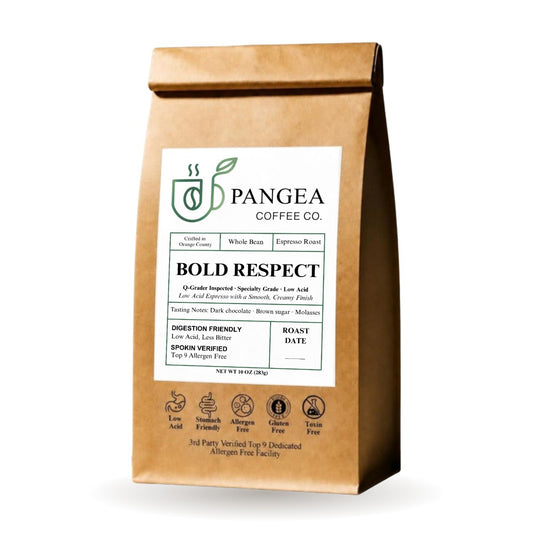
Pangea's Bold Respect: Mold-Free Espresso
Our Bold Respect Dark Roast is specifically designed for espresso lovers. It's SPOKIN-verified, low-acid, and has the bold, smooth profile that makes incredible espresso, and it's sensitive-stomach friendly.

How to Identify Mold-Free Coffee: Your Buying Checklist
Use this checklist when evaluating any coffee brand claiming to be mold-free:
SPOKIN Verification: Why It's the Gold Standard
SPOKIN is a third-party certification platform that verifies allergen-free products—and Pangea Coffee is proud to be SPOKIN-verified, making us the first coffee company in America to achieve this certification.
What SPOKIN Verification Means
- Independent third-party verification
- No Top-9 allergens anywhere in our roasting facility (milk, eggs, fish, shellfish, tree nuts, peanuts, wheat, soybeans, sesame)
- Strict contamination protocols prevent any cross-contact
- Transparent documentation available to consumers
For people with food allergies, mold sensitivities, or anyone seeking the cleanest possible coffee, SPOKIN verification provides peace of mind that no other "mold-free" marketing claim can match.

Real Customer Reviews: What People Say About Mold-Free Coffee
"This coffee has never hurt my stomach at all. I have tried other no-mold coffees that did not hold up to their promises. Not Pangea. I have tried the light, medium and dark roasts and all agreed with me. My favorite is Hope, the light Columbian roast. I am a customer fot life."
— Denise, Verified Buyer · April 2026
"This coffee is absolutely delicious. Now that I have started drinking the decaf, I’m able to drink coffee at night and this is a huge game changer. All coffee makes my stomach sick except for Pangea! Please never stop being allergy free because you’re a huge asset to the allergy free community."
— Allyson A., Verified Buyer · April 2026
"I’ve tried several low acid brands and Pangea has been my favorite by far. I feel like many of the other ones have a bitter aftertaste, or have an odd chemical taste, but Pangea tastes amazing, is super fresh, and, bonus, is the only low acid subscription that offers free shipping."
— Andy, Verified Buyer · June 2026
Frequently Asked Questions About Mold-Free Coffee
Gastroenterologist-Recommended: Why Dr. Salhab Recommends Pangea
Pangea is gastroenterologist-recommended — Dr. Joseph Salhab (@StomachDoc). Dr. Joseph Salhab is Sam's brother and a co-founder of Pangea Coffee.
What goes into every bag:
- SPOKIN-verified facility ensures no allergen cross-contamination
- Naturally low-acid processing for a sensitive-stomach friendly cup
- Q grader inspection ensures every batch meets quality standards
- Careful sourcing and storage to minimise mycotoxin risk
- Family-owned with personal commitment to food safety (our kids have food allergies)
For anyone who needs to avoid caffeine, we also roast our sugarcane-process low-acid decaf coffee. Unlike conventional decaf that uses harsh chemical solvents, our Sugarcane EA decaf uses naturally derived ethyl acetate from fermented sugarcane—providing the same low-acid, SPOKIN-verified quality with very little caffeine and without chemical residues. Read our complete decaf guide for GERD and acid reflux, or shop Pangea Decaf as a single bag or value 3-pack.

Try Pangea's SPOKIN-Verified Mold-Free Coffee
Ready to experience the difference that third-party verified, truly mold-free coffee makes?
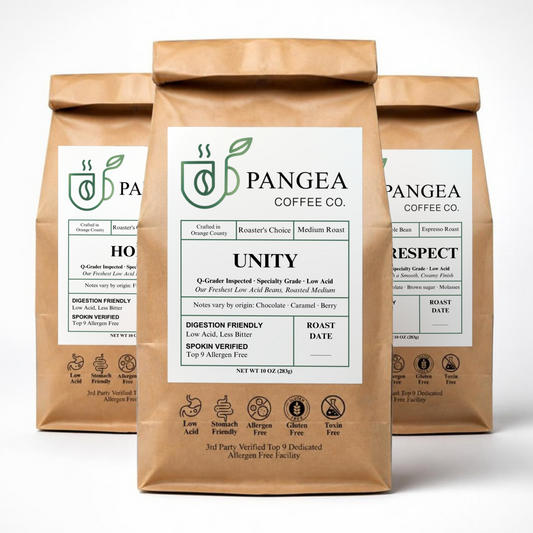
Our Top Picks for Mold-Free Coffee:
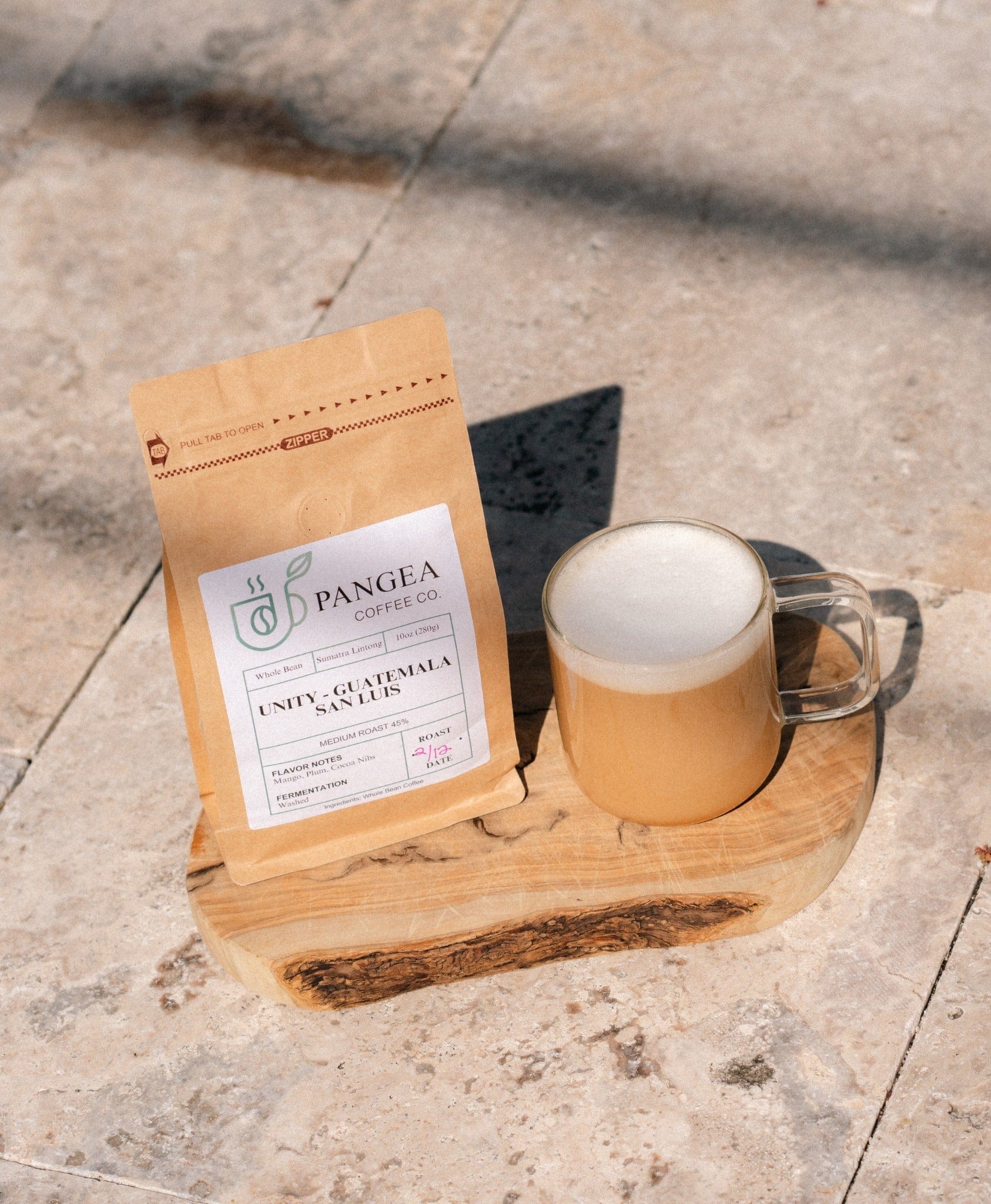
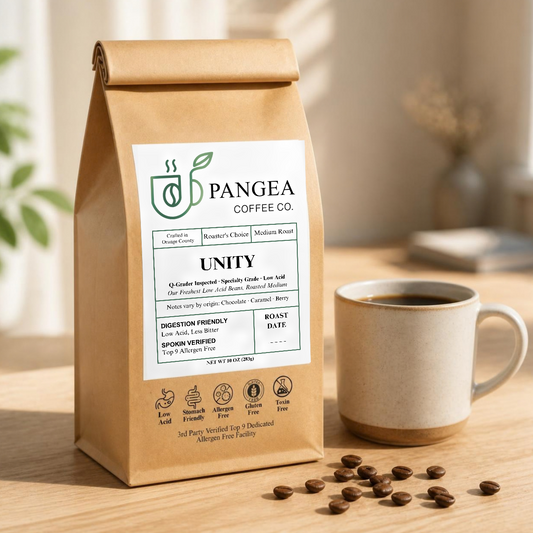
Unity Medium Roast
Our most popular blend, smooth and balanced with notes of chocolate and caramel. Perfect for everyday drinking.
Bold Respect Dark Roast
Rich, bold espresso roast that's sensitive-stomach friendly. Lowest perceived acidity of all our coffees.
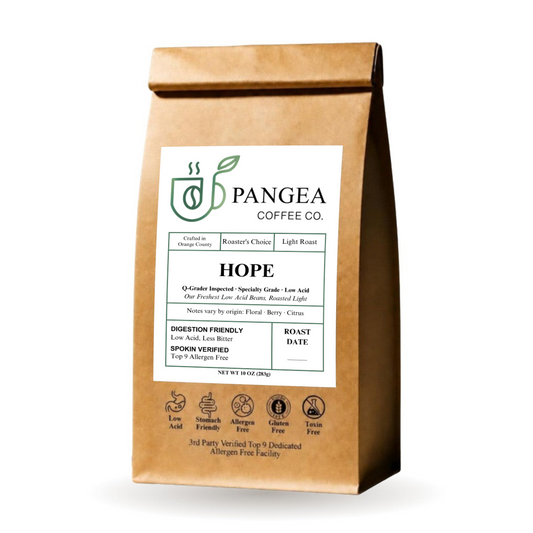
Hope Light Roast
Bright, fruity, and complex for light roast lovers who still want mold-free, low-acid coffee.
Not sure which to try?
Get our Discovery Pack with samples of all three roasts.

Our Commitment: Clean Coffee You Can Trust
At Pangea Coffee, we're not just another coffee brand making "mold-free" claims. We're a family-owned company with kids who have food allergies—this isn't just business for us, it's personal.
That's why we invested in becoming SPOKIN-verified, why we have Q graders on staff inspecting every batch, and why we're transparent about our processes. We're not perfect, but we're genuinely committed to providing the cleanest, safest, most delicious coffee possible.
When you choose Pangea, you're supporting:
- A family business that takes allergen safety seriously
- Third-party verified, not just self-proclaimed clean coffee
- Small-batch roasting for maximum freshness and quality
- Sustainable sourcing that supports coffee farmers
- Transparent practices—we're happy to answer any questions
Connect With Our Community
Join thousands of coffee lovers who've discovered clean, low-acid, mold-free coffee.
Follow us on Instagram: @pangea_coffee_co
Questions? Email us at info@pangeacoffee.us or DM us on Instagram. We're a small family team and we read every message.

Scientific References & Quality Standards
This article references peer-reviewed research on mycotoxins in coffee, food safety standards, and coffee quality protocols. Pangea Coffee maintains SPOKIN certification for allergen-free production and employs licensed Q graders for quality assurance.
References:
- Mycotoxins in Coffee: Suarez-Quiroz, M. L., et al. (2005). "Effect of the post-harvest processing procedure on OTA occurrence in artificially contaminated coffee." International Journal of Food Microbiology, 103(3), 339-345. PubMed
- Coffee Processing and Contamination: Batista, L. R., et al. (2009). "Ochratoxin A in coffee beans (Coffea arabica L.) processed by dry and wet methods." Food Control, 20(9), 784-790. DOI: 10.1016/j.foodcont.2008.10.003
- Roasting Effects on Mycotoxins: Bittner, A., Cramer, B., & Humpf, H.U. (2013). "Matrix binding of ochratoxin A during roasting." Journal of Agricultural and Food Chemistry, 61(51), 12737–12743. PubMed | DOI
- Specialty Coffee Quality Standards: Specialty Coffee Association. "Arabica Green Coffee Defect Handbook." SCA Coffee Standards Committee. SCA Standards
- SPOKIN Allergen Verification: SPOKIN Platform. "Third-Party Allergen Verification Process." SPOKIN
- European Food Safety Authority (EFSA): EFSA Panel on Contaminants in the Food Chain. "Opinion on ochratoxin A in food." EFSA Journal (2006). EFSA
Medical Disclaimer: This article is for informational purposes only and is not intended as medical advice. If you have mold sensitivity, food allergies, or digestive concerns, please consult with a qualified healthcare provider. Individual responses to coffee vary.
Quality Assurance: Pangea Coffee maintains SPOKIN certification for allergen-free production. Our Q graders (licensed coffee quality experts) inspect every batch. We source from high-altitude regions known for optimal growing conditions and employ optimal processing methods to minimize contamination risk. We do not currently conduct independent laboratory testing for mycotoxins, but rely on our sourcing standards, Q grader inspection, and SPOKIN-verified facility protocols to ensure clean coffee.
Last Updated: August 2026
Not sure which roast is right for you?
Answer five questions about your symptoms and we'll match you to a roast. Takes about thirty seconds, and you don't need to give us your email to see the result.
Find Your Roast →