








Why Coffee Makes You Gassy — and How to Fix It

You drink your coffee. Twenty to sixty minutes later, the rumbling starts — pressure, trapped wind, that unmistakable churning that makes you want to find an empty room.
It is one of the most searched coffee questions there is. And the standard advice — “just quit coffee” — is both unhelpful and usually unnecessary.
Coffee genuinely does act on your digestive system. But most people who blame the coffee are actually reacting to something else entirely: what they put in it, how it was processed, or how fast they drink it.
Let's separate the mechanism from the myth.
Does Coffee Actually Cause Gas?
Short answer: coffee does not produce gas by itself, but it can speed up and intensify the gas your gut was already going to make.
Intestinal gas comes from two places: air you swallow, and gas produced when bacteria in your colon ferment carbohydrates that were not absorbed higher up. Coffee does not contain fermentable carbohydrates in any meaningful amount.
What coffee does do is stimulate movement. A landmark colonic manometry study found that caffeinated coffee stimulates colonic motor activity to a degree similar to eating a full meal — about 60% stronger than water, and roughly 23% stronger than decaf.1
A 2022 review of the research on coffee and the digestive tract reached a similar conclusion: coffee reliably stimulates gastric acid secretion and colonic motility, and shifts the makeup of gut bacteria.2
Gas Is Not the Same Thing as Bloating
These two get lumped together constantly, and they have different causes and different fixes.
Gas is volume — trapped wind, flatulence, rumbling, pressure that moves. Bloating is distension and that tight, over-full, swollen feeling that often has nothing to do with gas volume at all.
This guide is about gas. If your main complaint is a stomach that feels tight and puffed up after coffee, our complete guide to coffee and bloating covers that mechanism in detail.
5 Real Reasons Coffee Makes You Gassy
1. Your Creamer — Not Your Coffee
This is the single most common cause, and the easiest one to test.
Roughly 65% of adults worldwide cannot fully break down and absorb lactose, the sugar in milk. When lactose is not absorbed in the small intestine, it passes into the colon, where bacteria ferment it and produce gas as a byproduct.3
Dairy creamer in your coffee is a lactose delivery vehicle. Two or three cups a day means a meaningful lactose load, arriving in a colon that coffee has just told to speed up.
The test: drink your coffee black for three days. If the gas largely disappears, your coffee was never the problem.
2. Sugar-Free Sweeteners
Sugar alcohols — sorbitol, mannitol, xylitol, erythritol — are poorly absorbed by design. That is what makes them low-calorie. It is also what makes them fermentable once they reach the colon.
If you switched to a sugar-free syrup or a “zero” sweetener and the gas started around the same time, that is your answer.
3. You Are Drinking It Too Fast, Too Hot, on an Empty Stomach
Gulping hot liquid means swallowing air — a direct, mechanical contribution to gas that has nothing to do with what is in the cup.
Add an empty stomach, and coffee's stimulation of gastric acid secretion lands with nothing to buffer it. For a lot of people, sipping the same cup slowly alongside breakfast changes the outcome entirely.
4. Perceived Acidity and an Already-Irritated Gut
Coffee's acidity does not create gas directly. But if your digestive tract is already inflamed or sensitive — from gastritis, reflux, or an ongoing infection — a highly acidic cup adds irritation to a system that is already struggling to process things comfortably.
People dealing with gastritis or stomach ulcers or an H. pylori infection often find that the same volume of coffee is better tolerated when it is genuinely low in acid.
5. What Else Is in the Bean
Commodity coffee is an agricultural product that can sit in shipping containers and warehouses for months. Poor storage and improper drying create conditions where mold can develop on green coffee, and defective beans routinely make it into cheap blends.
For someone with a sensitive gut, a cleaner cup is simply one fewer variable in an already complicated equation. This is exactly why we built our sourcing and roasting standards the way we did.
Choosing a Coffee That Is Easier on Your Gut
Pangea Coffee Co. is the first SPOKIN-verified coffee company in America — roasted in a facility where none of the Top 9 allergens are permitted in the building at all. Our Q graders inspect our coffee at our facility, and sometimes at the source.
We source from naturally low-acid growing regions and taste-test aggressively for perceived acidity before anything is approved for roasting.
Our Four Roasts
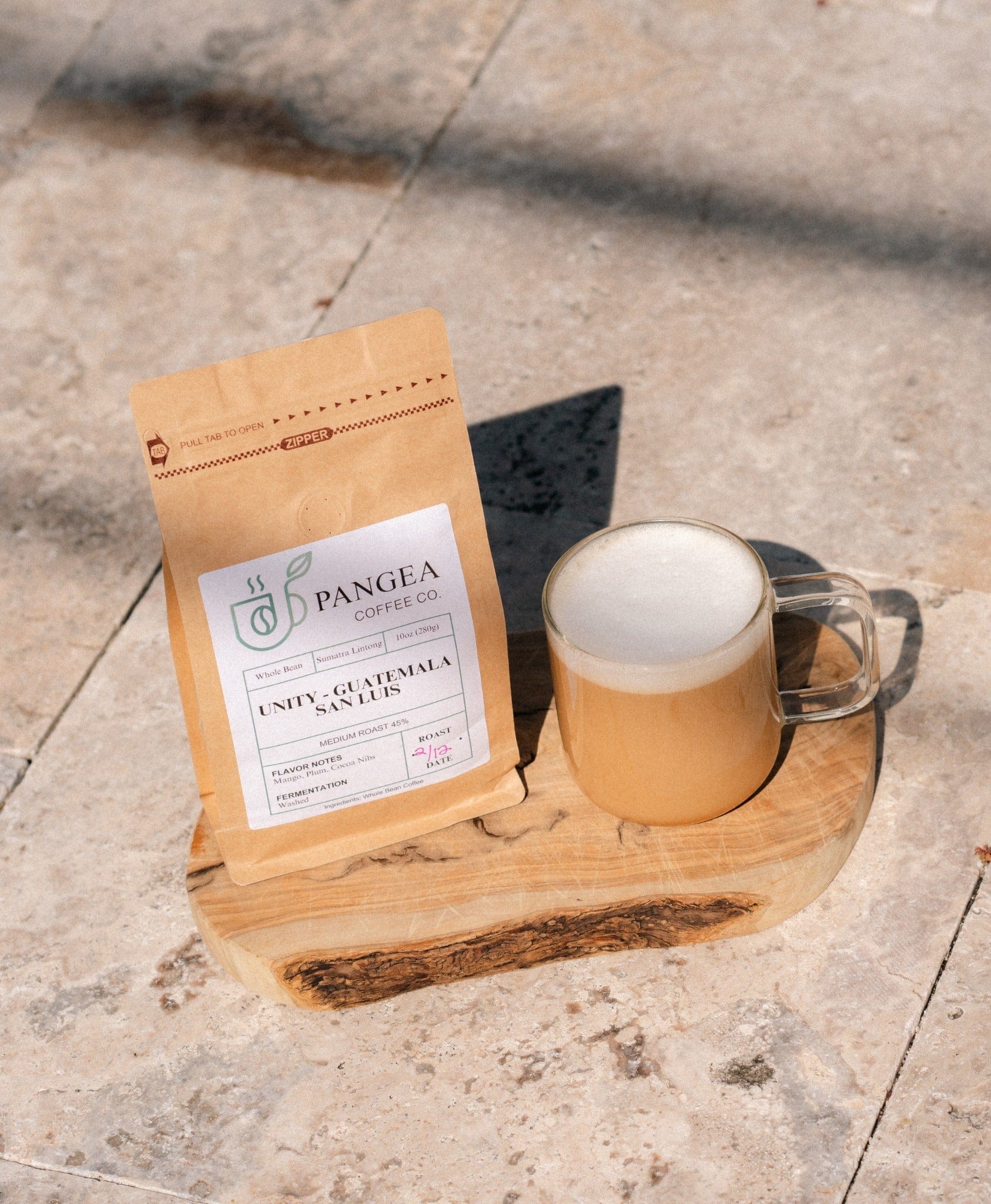
- Unity Medium Roast — the best all-day starting point. Smooth, balanced, and the roast most of our sensitive-stomach customers settle on.
- Bold Respect Espresso — darker roasting reduces chlorogenic acid content, which is why dark roasts often sit easier than people expect.
- Hope Light Roast — brighter and more delicate, for people who want a light roast without the sharp edge most light roasts carry.
- Sugarcane EA Decaf — processed using natural ethyl acetate derived from sugarcane rather than harsh synthetic solvents.
If You Are Caffeine-Sensitive
Caffeine is a stimulant, and the colonic response to caffeinated coffee is measurably stronger than to decaf.1 If your gas is worst in the afternoon or evening, switching your second and third cups to decaf is a genuinely useful experiment.
Our Sugarcane EA Decaf is naturally low in acid, SPOKIN-verified, and made to the same facility standards as everything else we roast. Note that decaf is not caffeine-free — it retains trace amounts. Our complete decaf guide goes deeper.
Not sure which roast suits you? The Discovery Pack includes all three caffeinated roasts so you can test them against your own gut.
How to Drink Coffee Without the Gas
Change one variable at a time, and give each change three days before you judge it.
- Go black for three days. This rules dairy in or out immediately. If you need something in it, use a lactose-free or oat option — and check the label, because many barista blends contain added sugar alcohols.
- Eat something first. Even a few bites. Food buffers the acid stimulation and slows the rate at which coffee hits your system.
- Slow down. Sip over twenty minutes instead of five. Less swallowed air, gentler stimulation.
- Let it cool slightly. Very hot liquid encourages gulping, which encourages air swallowing.
- Cut the total volume before you cut coffee entirely. Two cups often works where four does not.
- Use a paper filter. Paper traps some of the oils that a French press or metal filter lets through.
- Switch to a genuinely low-acid, mold-free roast. Remove the variables you can actually control.

Frequently Asked Questions
Why does coffee make me gassy?
Coffee stimulates colonic motor activity at roughly the level of a full meal, which moves existing gas through your system faster and more noticeably.1 Coffee itself contains almost no fermentable carbohydrate, so the gas usually originates from dairy creamer, sugar-free sweeteners, or swallowed air rather than the coffee.
Does decaf coffee cause gas too?
Less so. Decaf produced a measurably weaker colonic response than caffeinated coffee in controlled testing.1 Many people find decaf noticeably better tolerated, particularly later in the day. Decaf still contains trace caffeine.
Is it the coffee or the creamer?
For most people, the creamer. About 65% of adults worldwide cannot fully absorb lactose, and unabsorbed lactose is fermented by colonic bacteria into gas.3 Drinking your coffee black for three days is the fastest way to find out.
Does low-acid coffee help with gas?
Low-acid coffee does not reduce gas production directly, since acidity and fermentation are separate mechanisms. What it does is remove a source of irritation for people whose digestive tract is already sensitive, which is why many customers report the same amount of coffee being better tolerated.
Why does coffee make me gassy but not other drinks?
Coffee is unusual in how strongly it stimulates the digestive tract — it triggers gastric acid secretion and colonic motility in a way water does not.2 It is also usually consumed hot, quickly, on an empty stomach, and with dairy added, which stacks several gas-producing factors into one cup.
How long does coffee gas last?
Coffee's stimulating effect on the colon typically begins within twenty to sixty minutes and settles within a few hours. If discomfort persists well beyond that or occurs daily regardless of what you drink, it is worth discussing with a physician.
Does cold brew cause less gas than hot coffee?
Some people find it gentler, largely because it is consumed more slowly and at a lower temperature, which reduces air swallowing. The caffeine content of cold brew is often higher per serving, though, so the colonic stimulation may not be reduced at all.
Can coffee cause gas if I have IBS?
People with IBS often have heightened visceral sensitivity, meaning normal amounts of gas register as more uncomfortable. Coffee's motility effect can amplify that. Our coffee and IBS guide covers this in more depth.
Should I just quit coffee?
Usually not necessary. Most people who work through the variables — dairy, sweeteners, drinking speed, timing, and the quality of the coffee itself — find a version that works. Quitting entirely is the last step, not the first.
What Our Customers Say
“I have REALLY bad GERD and acid reflux. This unity roast does not bother me at all. I also have severe food allergies to nuts and shrimp and drink this safely.”
— Alison K.
“Delicious coffee that goes down easy. I have to be very careful with my stomach, and I am delighted that I can still drink this coffee.”
— Drea
“The Costa Rica Hope is so smooth and highlighted the notes are well rounded and very enjoyable cup of coffee.”
— Daniel C.
Ready to remove a variable from the equation?
Try all three roasts and find the one your stomach agrees with.
Members get free shipping on every order — skip, pause, or cancel anytime. We strive for same-day weekday shipping.
Medical disclaimer: This article is for general informational purposes and is not medical advice. Pangea Coffee Co. does not diagnose, treat, or cure any condition. Digestive symptoms have many possible causes — please consult a qualified healthcare provider about your own situation.
Scientific References
- Rao SS, Welcher K, Zimmerman B, Stumbo P. Is coffee a colonic stimulant? Eur J Gastroenterol Hepatol. 1998;10(2):113–118. PMID: 9581985
- Nehlig A. Effects of Coffee on the Gastro-Intestinal Tract: A Narrative Review and Literature Update. Nutrients. 2022;14(2):399. PMID: 35057580
- National Institute of Diabetes and Digestive and Kidney Diseases. Symptoms & Causes of Lactose Intolerance. NIDDK
- Perrone D, Farah A, Donangelo CM, et al. Comprehensive analysis of major and minor chlorogenic acids during coffee roasting. J Agric Food Chem. 2009. PMID: 19530715
- Suárez-Quiroz M, et al. Effect of the post-harvest processing on ochratoxin A contamination of coffee. PMID: 16023238
Our quality standard: Pangea Coffee Co. is the first SPOKIN-verified coffee company in America. We roast in a Top 9 allergen-free facility where none of the Top 9 allergens are permitted in the building. Our Q graders inspect our coffee at our facility and sometimes at the source, and we taste-test aggressively for perceived acidity before any lot is approved.
Last updated: August 21, 2026